
- Internet
- Encyclopedia
- Knowledge from my Parents
jueves, 20 de noviembre de 2008

sábado, 15 de noviembre de 2008
Visit China
First of all, if you want to visit china you must know certain things about this beautiful place, like:
Location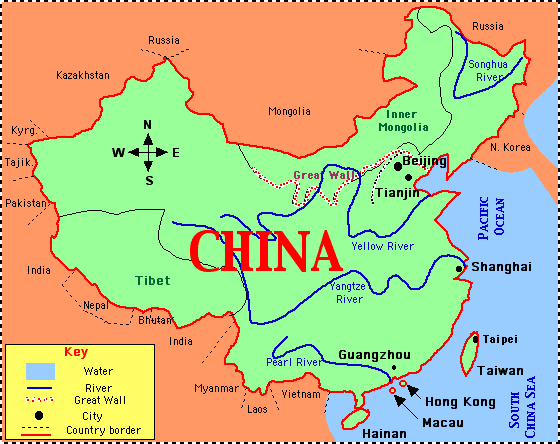
The People's Republic Of China or just China is located in Eastern Asia and takes over a great piece of land from this continent.
Climate
The climate of China varies greatly. The northern zone has summer daytime temperatures of more than 30 degrees Celsius and winters of Artic severity, which makes this part of the country a nice place to visit in the summer and in the winters if you like really cold climates. The central zone has a Temperate Continental Climate with very hot summers and cold winters. The southern zone has a subtropical climate with very hot summers and mild winters.
Landmarks To Visit
The Grand Canal of China

The Grand Canal of China is the world's oldest and longest canal, far surpassing the next two grand canals of the world: the Suez and Panama Canals. It goes from Beijing to Hangzhou and is 1,795 kilometers (1,114 miles) long with 24 locks and about 60 bridges, the longest and 2,500-year-old man-made waterway depicts the greatness of the Ancient Chinese.
The canal's History:
The Grand Canal In The Sui Dynasty
The Grand Canal as we see it today was in large part a creation of the Sui Dynasty (581-618), a result of the migration of China’s core economic and agricultural region away from the Yellow River valley and toward what is now Jiangsu and Zhejiang provinces. Its main role throughout its history was the transport of grain to the capital. However, the institution of the Grand Canal by the Sui also obviated the need for the army to become self-sufficient farmers while posted in the northern frontier, as food supplies could now easily be shipped from south to north over the pass.
The Grand Canal In Ming Dynasty
The Grand Canal was renovated almost in its entirety between 1411 and 1415 during the Ming Dynasty (1368–1644).

The Great Wall of China
Over 6,000 kilometers long, the Great Wall is the symbol of the Chinese nation as well as one of the seven great wonders of the world. Even from the moon one can recognize two of the most giant wonders on earth, one of them being China's 2,000-year-old Great Wall.
The Wall's History
During the Warring States Period from the 5th century BC to 221 BC, the states of Qi, Yan and Zhao all co nstructed extensive fortifications to defend their own borders. Qin Shi Huang conquered all opposing states and unified China in 221 BC, establishing the Qin Dynasty. Intending to impose centralized rule and prevent the resurgence of feudal lords, he ordered the destruction of the wall sections that divided his empire along the former state borders. To protect the empire against intrusions by the Xiongnu people from the north, he ordered the
 building of a new wall to connect the remaining fortifications along the empire's new northern frontier.
Later the following dynasties just repaired, rebuilt, or expanded sections of the wall.
Huang Long
Huang Long, meaning "Yellow Dragon", lies in the south part of Min Mountain in Song Pan County of Sichuan in southwest China. It was denominated a special scenic spot of China in 1982 and entered into "The Natural Legacy Lists of the World" in 1992. I t covers an area of about 700 square kilometers and has two parts: Huang Long and Muni Gorge. Huang Long
 includes Huang Long Valley, Danyun Gorge, Snow Treasure Peak, while Muni Gorge comprises two scenic spots: the Zhaga Waterfall and the Erdao Lake.
Huang Long scenic spot has very special sceneries, rich natural resources, and primeval forest. Huanglong is thus called "A Fairyland on Earth". There are snow mountains just like those in Canada, the Great Gorge in America, the primeval forest in Colorado, and the glamourous ponds in Huangshi Park. With so many wonderful views gathered in one place, Huang Long is not only the treasure of China, but also the treasure of the world.
Culture
The Culture of China is one of the world's oldest and most complex cultures. The area in which the culture is dominant covers a large geographical region with customs and traditions varying greatly between towns, cities and provinces. Each region is usually divided into distinct sub-cultures.
Language
Spoken Chinese has consisted of a number of Chinise Dialects and Languages throughout history. In the Ming Dynasty Standard Mandarin was nationalized. Even so, it wasn't until the Republic of China era in the 1900's when there was any noticeable result in promoting a common unified language in China. The ancient written standard was Classical Chinese. It was used for thousands of years, but was mostly reserved for scholars and intellectuals.
Mythology And Spirituality
A large part of Chinese culture is based on the notion that a spiritual world exists. Countless methods of Divination have helped answer questions, even serving as an alternate to medicine.
Music
The music of China dates back to the dawn of Chinese Civilization with documents and artifacts providing evidence of a well-developed musical culture as early as the Zhou Dynasty. Some of the oldest written music dates back to Confucius's time.
Food

Chinese cuisine originated from the various regions of China and has become widespread in many other parts of the world from Asia to America, Australia, Western Europe, and Southern Africa. In recent years, connoisseurs of Chinese cuisine have also sprouted in Eastern Europe and South Asia.
- It's Location
- Climate
- Interesting And Exciting Places You Can visit in China!
- Culture
- Food
Location
The People's Republic Of China or just China is located in Eastern Asia and takes over a great piece of land from this continent.
Climate
The climate of China varies greatly. The northern zone has summer daytime temperatures of more than 30 degrees Celsius and winters of Artic severity, which makes this part of the country a nice place to visit in the summer and in the winters if you like really cold climates. The central zone has a Temperate Continental Climate with very hot summers and cold winters. The southern zone has a subtropical climate with very hot summers and mild winters.
Landmarks To Visit
The Grand Canal of China
The Grand Canal of China is the world's oldest and longest canal, far surpassing the next two grand canals of the world: the Suez and Panama Canals. It goes from Beijing to Hangzhou and is 1,795 kilometers (1,114 miles) long with 24 locks and about 60 bridges, the longest and 2,500-year-old man-made waterway depicts the greatness of the Ancient Chinese.
The canal's History:
The Grand Canal In The Sui Dynasty
The Grand Canal as we see it today was in large part a creation of the Sui Dynasty (581-618), a result of the migration of China’s core economic and agricultural region away from the Yellow River valley and toward what is now Jiangsu and Zhejiang provinces. Its main role throughout its history was the transport of grain to the capital. However, the institution of the Grand Canal by the Sui also obviated the need for the army to become self-sufficient farmers while posted in the northern frontier, as food supplies could now easily be shipped from south to north over the pass.
The Grand Canal In Ming Dynasty
The Grand Canal was renovated almost in its entirety between 1411 and 1415 during the Ming Dynasty (1368–1644).
The Great Wall of China
Over 6,000 kilometers long, the Great Wall is the symbol of the Chinese nation as well as one of the seven great wonders of the world. Even from the moon one can recognize two of the most giant wonders on earth, one of them being China's 2,000-year-old Great Wall.
The Wall's History
During the Warring States Period from the 5th century BC to 221 BC, the states of Qi, Yan and Zhao all co
nstructed extensive fortifications to defend their own borders. Qin Shi Huang conquered all opposing states and unified China in 221 BC, establishing the Qin Dynasty. Intending to impose centralized rule and prevent the resurgence of feudal lords, he ordered the destruction of the wall sections that divided his empire along the former state borders. To protect the empire against intrusions by the Xiongnu people from the north, he ordered the building of a new wall to connect the remaining fortifications along the empire's new northern frontier.Later the following dynasties just repaired, rebuilt, or expanded sections of the wall.
Huang Long
Huang Long, meaning "Yellow Dragon", lies in the south part of Min Mountain in Song Pan County of Sichuan in southwest China. It was denominated a special scenic spot of China in 1982 and entered into "The Natural Legacy Lists of the World" in 1992. I
t covers an area of about 700 square kilometers and has two parts: Huang Long and Muni Gorge. Huang Long includes Huang Long Valley, Danyun Gorge, Snow Treasure Peak, while Muni Gorge comprises two scenic spots: the Zhaga Waterfall and the Erdao Lake.Huang Long scenic spot has very special sceneries, rich natural resources, and primeval forest. Huanglong is thus called "A Fairyland on Earth". There are snow mountains just like those in Canada, the Great Gorge in America, the primeval forest in Colorado, and the glamourous ponds in Huangshi Park. With so many wonderful views gathered in one place, Huang Long is not only the treasure of China, but also the treasure of the world.
Culture
The Culture of China is one of the world's oldest and most complex cultures. The area in which the culture is dominant covers a large geographical region with customs and traditions varying greatly between towns, cities and provinces. Each region is usually divided into distinct sub-cultures.
Language
Spoken Chinese has consisted of a number of Chinise Dialects and Languages throughout history. In the Ming Dynasty Standard Mandarin was nationalized. Even so, it wasn't until the Republic of China era in the 1900's when there was any noticeable result in promoting a common unified language in China. The ancient written standard was Classical Chinese. It was used for thousands of years, but was mostly reserved for scholars and intellectuals.
Mythology And Spirituality
A large part of Chinese culture is based on the notion that a spiritual world exists. Countless methods of Divination have helped answer questions, even serving as an alternate to medicine.
Music
The music of China dates back to the dawn of Chinese Civilization with documents and artifacts providing evidence of a well-developed musical culture as early as the Zhou Dynasty. Some of the oldest written music dates back to Confucius's time.
Food
Chinese cuisine originated from the various regions of China and has become widespread in many other parts of the world from Asia to America, Australia, Western Europe, and Southern Africa. In recent years, connoisseurs of Chinese cuisine have also sprouted in Eastern Europe and South Asia.
I Hope that You Like My "Visit China" Guide!
Thank You For Reading And....
Remember To Visit China!!
Good Luck To You All!
Thank You For Reading And....
Remember To Visit China!!
Good Luck To You All!
Hotel
I Reccomend you to stay in this amazing hotel: The Waterworld

Suscribirse a:
Entradas (Atom)